Pixie cut for round face
Yes, a pixie cut works on a round face, provided you choose its lengths from your own face width and hair density rather than from a photograph of somebody else.
| Band | Cheekbone width divided by jaw width | Length left on top | Side piece in front of the ear |
|---|---|---|---|
| Narrow round | 1.18 or higher | 5 to 7 centimetres (2.0 to 2.8 inches) | 4 to 5 centimetres (1.6 to 2.0 inches) |
| Middle round | 1.09 to 1.17 | 7 to 9 centimetres (2.8 to 3.5 inches) | 5 to 7 centimetres (2.0 to 2.8 inches) |
| Wide round | 1.00 to 1.08 | 9 to 12 centimetres (3.5 to 4.7 inches) | 6 to 8 centimetres (2.4 to 3.1 inches) |
If your hair is thick, in any band, the cut will push outward as it dries, so have the lower half thinned before the cut begins. The two boundaries of these three bands, 1.08 and 1.18, are the rule given on this page, not an industry standard: measure by them, and if your ratio falls on a boundary, cut to the longer band, and go shorter at the next appointment if you are not satisfied with it.
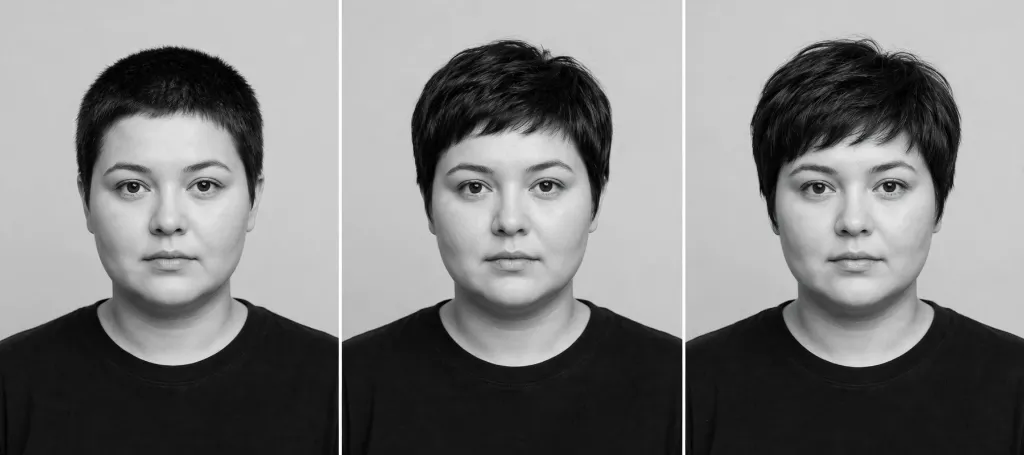
Work out which kind of round face you have
Do not judge this in a mirror. Take two widths with a rigid ruler held straight across the front of your face, never wrapped around the curve of it. First, read the distance between the two outermost points of your cheekbones. Second, read the distance between the two angles of your jaw, below your ears. Keep your hair pulled away from both points, and write both numbers down in centimetres to one decimal place. Measure each width twice. If the two readings for one width differ by more than 0.3 centimetres (0.1 inches), measure a third time and use the middle value.
Now divide the cheekbone width by the jaw width. A cheekbone width of 14.2 centimetres (5.6 inches) over a jaw width of 11.9 centimetres (4.7 inches) gives 1.19, which is the narrow round band. A cheekbone width of 14.0 centimetres (5.5 inches) over a jaw width of 12.4 centimetres (4.9 inches) gives 1.13, which is the middle round band. A cheekbone width of 13.9 centimetres (5.5 inches) over a jaw width of 13.1 centimetres (5.2 inches) gives 1.06, which is the wide round band. On this page, every length is set only by the ratio you measured, not by the photograph you saved.
Each band then fixes three numbers. The narrow round band keeps 5 to 7 centimetres (2.0 to 2.8 inches) on top, because a jaw that is clearly narrower than the cheekbones already removes width low on the face. The middle round band keeps 7 to 9 centimetres (2.8 to 3.5 inches) on top, enough to lift the outline upward without leaving a shelf of hair at the sides. The wide round band keeps 9 to 12 centimetres (3.5 to 4.7 inches) on top and 6 to 8 centimetres (2.4 to 3.1 inches) in the piece in front of the ear, because the jaw is nearly as wide as the cheekbones and a shorter top would leave all the width at face level. If your ratio lands within 0.02 of a boundary, choose the longer band for the first cut. You can take more off at a second appointment; you cannot put any back.
Four pixie shapes, with the lengths for each
Long pixie
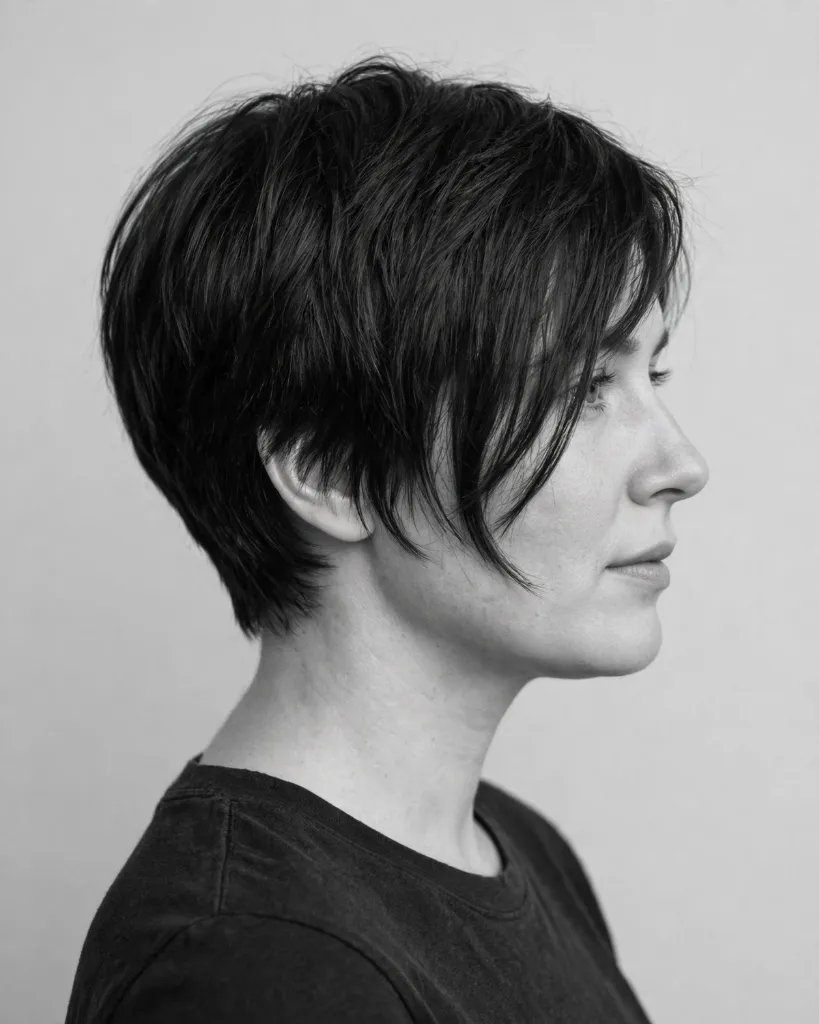
Fits the middle and wide round bands. Leave 9 to 12 centimetres (3.5 to 4.7 inches) on top, 3 to 4 centimetres (1.2 to 1.6 inches) over the ears, and 1.5 to 2.5 centimetres (0.6 to 1.0 inches) at the nape, with the front section ending at cheekbone level. Not for fine hair cut in one blunt level, which needs broken layers instead, and not for anyone who will not spend two or three minutes arranging the front each morning.
Short pixie
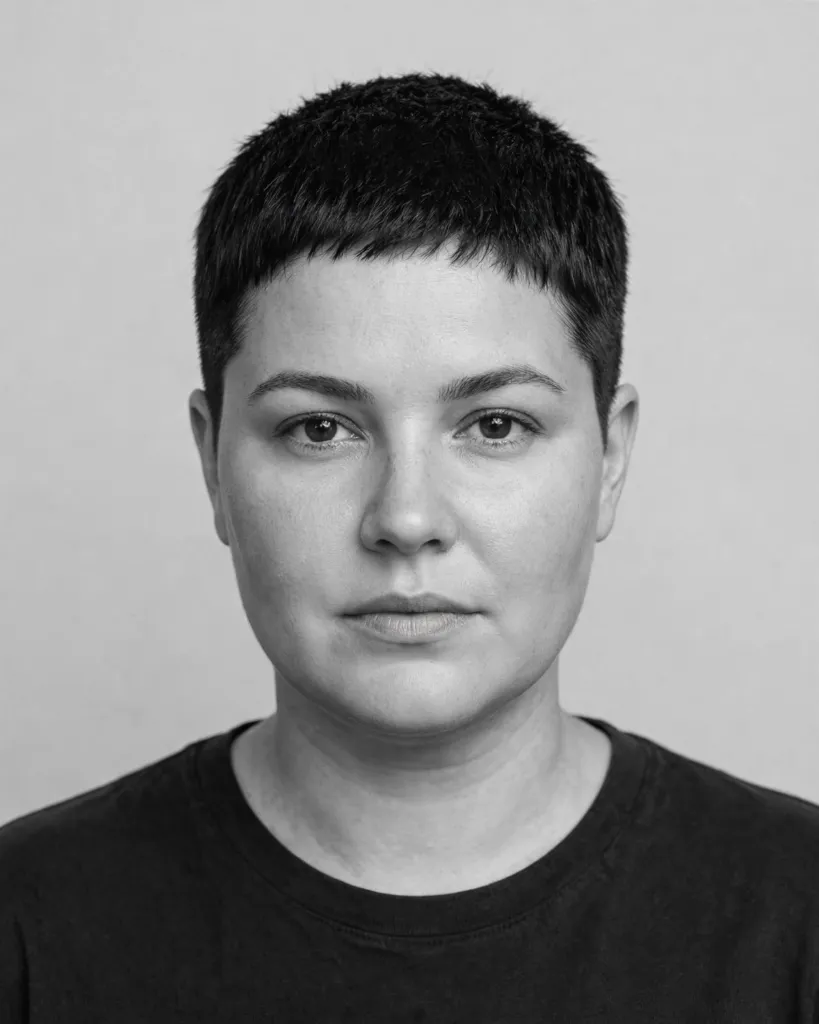
Fits the narrow round band, and the middle band only when the sides are kept close. Leave 5 to 7 centimetres (2.0 to 2.8 inches) on top, 1.5 to 2.5 centimetres (0.6 to 1.0 inches) at the sides, and 1.0 to 1.8 centimetres (0.4 to 0.7 inches) at the nape. Not for the wide round band, and not for thick hair that has not first been taken down in its lower half, because untreated sides will stand away from the head.
Pixie with longer side pieces
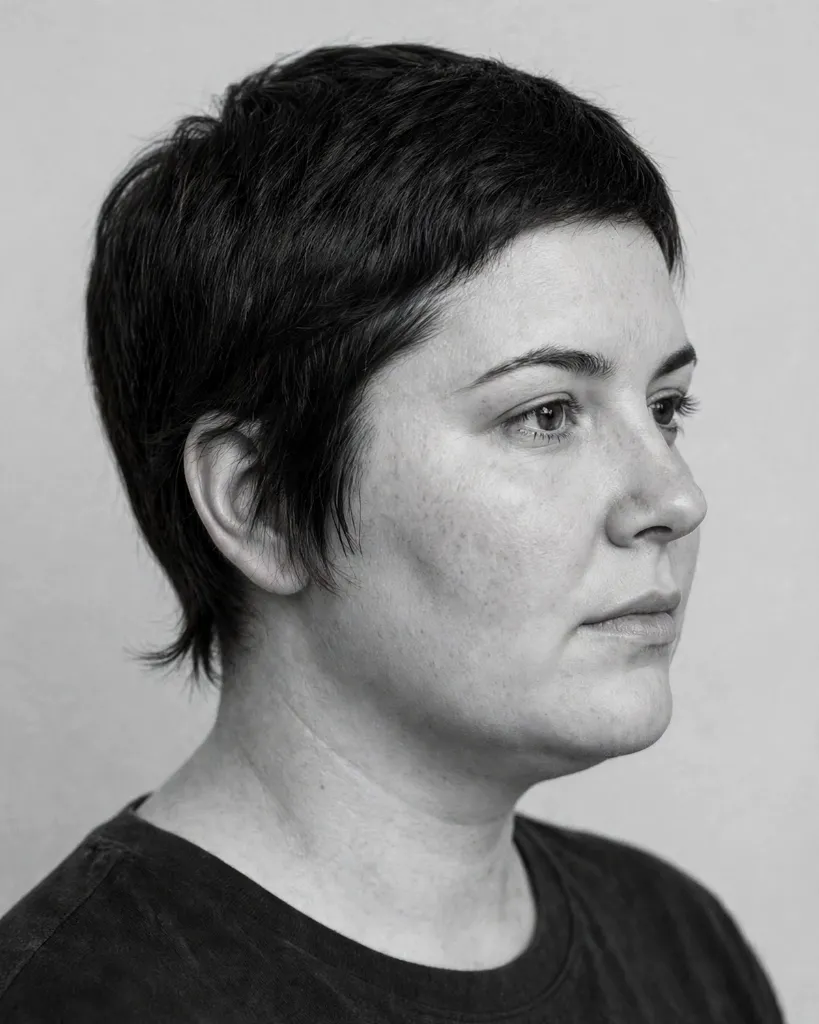
Fits the wide and middle round bands. Leave 7 to 10 centimetres (2.8 to 3.9 inches) on top, 6 to 9 centimetres (2.4 to 3.5 inches) in the pieces in front of the ears so they end between the middle of the ear and the earlobe, and 1.5 to 2.0 centimetres (0.6 to 0.8 inches) at the nape. Not for side hair that springs outward at ear level and will not be pressed down each day, because an outward flick at the ear adds width at exactly the wrong height.
Pixie with a lifted top
Fits the wide and middle round bands, and thick hair once the lower half has been taken down. Leave 8 to 11 centimetres (3.1 to 4.3 inches) on top, which is the length you can pinch between finger and thumb and lift, 2 to 3 centimetres (0.8 to 1.2 inches) at the sides, and 1.5 to 2.5 centimetres (0.6 to 1.0 inches) at the nape. Not for a top shorter than 5 centimetres (2.0 inches), because there is nothing to pinch, and not for anyone who will not use wax at all.
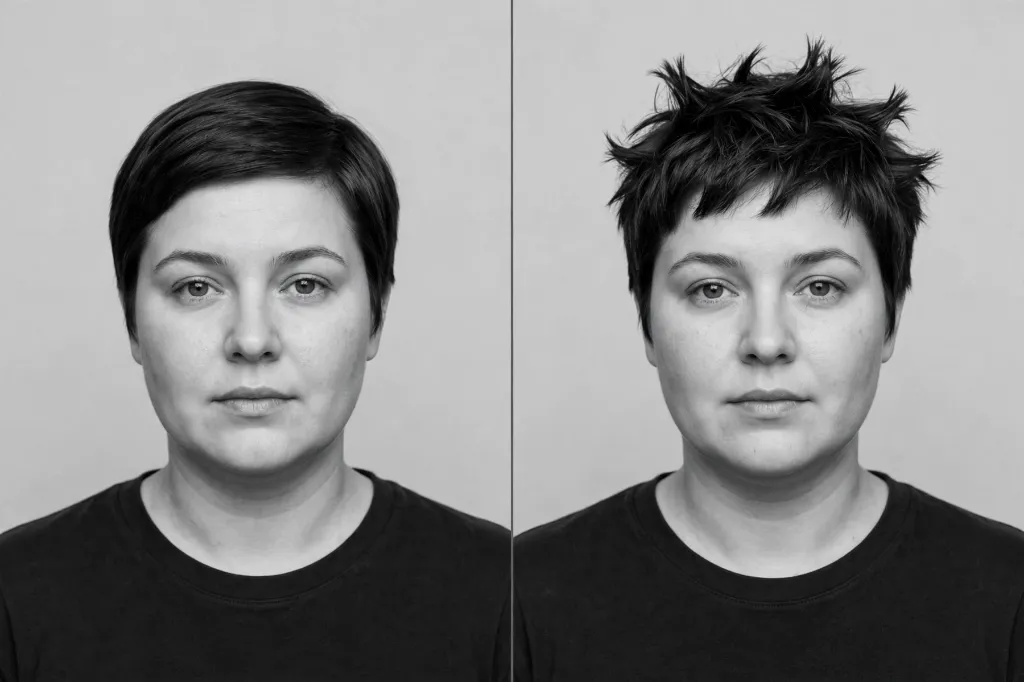
Thick hair on a round face: how to stop the cut pushing outward
Dense hair is the most common reason a pixie on a round face disappoints. The shape looks controlled in the chair, then expands sideways as it dries, and the outline ends up wider than the hair you started with. Spreading thinning shears through the whole cut makes this worse, not better: the shortened hairs inside push the surface outward, and the fine ends fly. Work on the lower half, shorten the nape, and check the shape dry. Those three moves, in that order, are the whole method.
First, point-cut the ends and thin the lower half only. Ask for thinning shears or a razor on the lower half of the side and back sections, with the surface layer left whole so it can lie over the worked hair and hold it down. This is also where a wispy, separated finish comes from: it is made with thinning shears on the ends, never by pressing the hair straight. Keep the wispy work to the last 0.5 centimetres (0.2 inches) of each section, so the ends separate without the whole section losing its weight.
Second, take the nape shorter than everything else. Finish the nape at 1.0 to 1.8 centimetres (0.4 to 0.7 inches), cut 0.5 to 1.0 inch (1.3 to 2.5 centimetres) shorter than the length left at the sides. Hair at the nape grows outward first, and a short nape is what stops the back of the cut turning into a second curve behind the jaw. Third, judge the result dry, not wet. If the sides still push out once the hair is dry, shorten the bulky zone itself by 0.5 centimetres (0.2 inches) at a time and check again, rather than adding more thinning. Choose the person for this work from evidence: a stylist whose own photographs show short cuts on women, rather than clipper work on men alone, and say so when you book.
At home, the top is what keeps the shape narrow. Work a bead of wax about 0.5 centimetres (0.2 inches) across through the top while it is dry, then pinch the top into sections 1 to 2 centimetres (0.4 to 0.8 inches) wide and set each section at a slight angle. Separated pieces read as height. One smooth surface reads as width, however it was cut.
If you are still weighing a pixie against longer options, compare the full set of hairstyles for a round face first, then narrow the field with the round-face haircut shortlist before you book the appointment.
Before you commit: three questions and a way back
The honest worry is not whether a pixie exists for a round face, but whether you will regret it in the mirror a week later, especially if you are not slim and the face in the photograph is.
One more check before those questions. Measure the straight drop from your earlobe to the tip of your chin. If it comes to less than 2.25 inches (5.7 centimetres), short hair will in most cases suit you. If it comes to more than 2.25 inches (5.7 centimetres), do not commit to the full cut yet; try the side pieces first.
Answer these three questions with numbers, not feelings. One: which band did your own two measurements give you, and is the length you want the length written for that band? Two: will you genuinely spend two minutes pinching the top with wax on an ordinary weekday morning? Three: can you get back to a salon every four to six weeks, while the cut grows through the stage where the sides reach their widest?
If any answer is no, do not cancel the idea; split it into two appointments. At the first, cut only to the long version of your band: 10 to 12 centimetres (3.9 to 4.7 inches) on top and side pieces of 8 to 9 centimetres (3.1 to 3.5 inches), and start by testing the pieces in front of the ears at 6 to 7 centimetres (2.4 to 2.8 inches). Live with that for fourteen days. At the second appointment, shorten the top by 1 to 2 centimetres (0.4 to 0.8 inches) if you still want to. A two-stage cut costs one extra visit and removes the one regret that cannot be undone.
Say this to your stylist
These three lines are complete as they stand. Read them out exactly.
"Have you cut a pixie on a thick, round face before, and may I see a photograph of that cut in your own work?"
"Please thin only the lower half of the sides and back, and take the nape 0.5 to 1.0 inch (1.3 to 2.5 centimetres) shorter than the sides."
"Please leave 8 to 10 centimetres (3.1 to 3.9 inches) on top, so I can pinch it up with wax into separate pieces."
Disclosure: FaceShapeLens may earn an affiliate commission from qualifying purchases made through links on this page at no additional cost to you.