Chubby Face Pixie Cut: Hair Density, Crown Scaffolding, and Jawline Weight
Yes, you can wear a pixie cut with a chubby face, but two specific missteps will widen the silhouette immediately: cutting a blunt, horizontal perimeter across the widest line of your cheeks, and stripping exterior density until the top collapses flat against the skull. What decides whether a pixie cut flatters a fat face is not the geometry of your bone structure, but the mechanical density and texture of your hair.
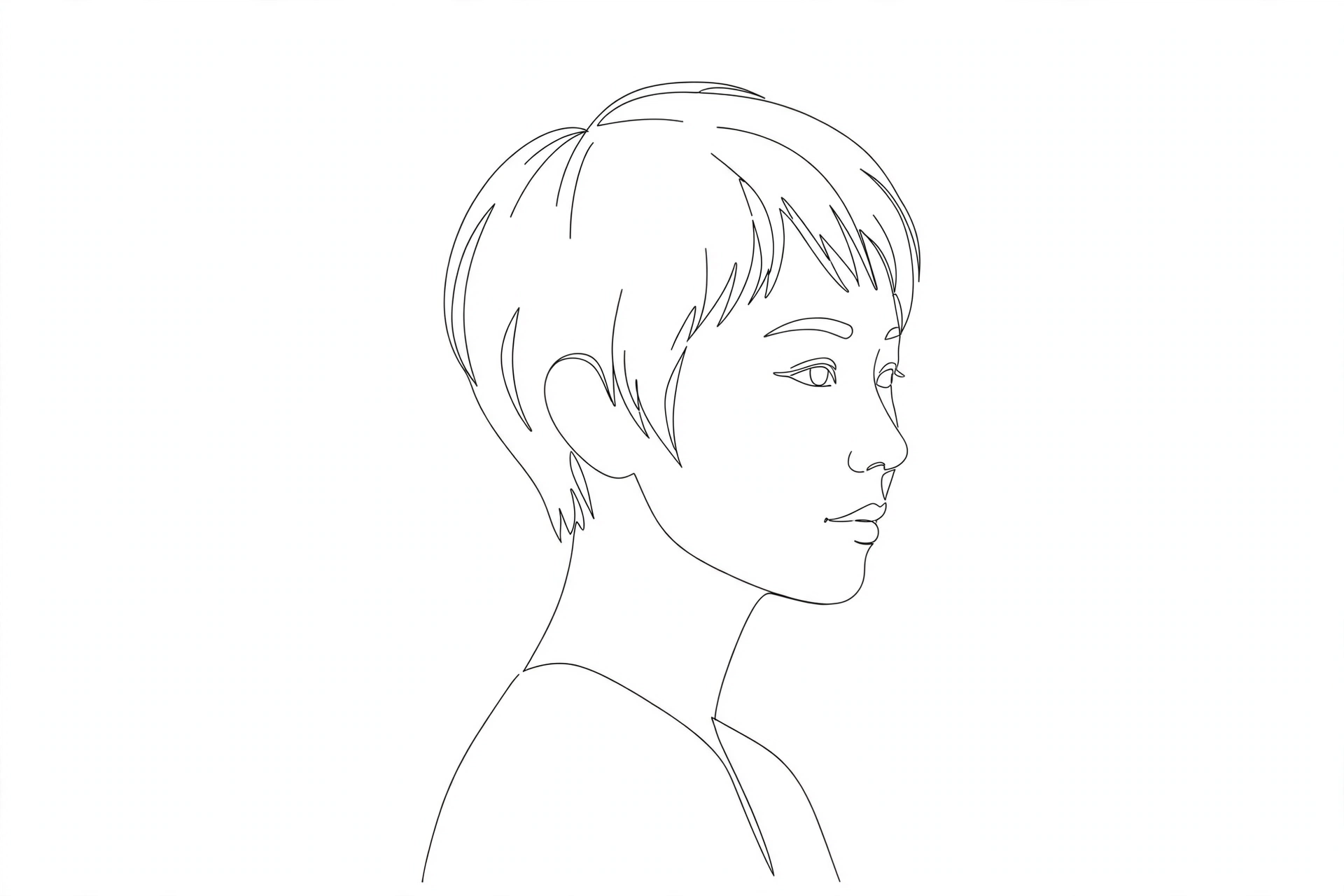
Thin or Fine Hair on a Chubby Face: The Hidden Crown Scaffolding
Fine hair on a chubby face collapses under gravity faster than thick hair, flattening against the temporal bones and leaving the fullness of the cheeks entirely unsupported. The standard salon reaction is to sheer the visible exterior layers shorter, assuming less weight will create volume. It rarely works: ultra-short fine hair separates into gaps, exposes the scalp under bright light, and offers zero structural lift.
The durable solution is a hidden internal shelf rather than a cropped surface canopy. Your stylist must cut interior support layers 3 to 4 centimetres (1.2 to 1.6 inches) from the scalp beneath the crown. Take the weight out of the surface layer, let the layer underneath carry it, and the crown keeps its height. Over this structural scaffolding, leave an uncut exterior canopy of 7 to 9 centimetres (2.8 to 3.5 inches). The longer surface hair drapes seamlessly over the rigid under-layer, creating visible crown height without exposing choppy ends or flyaways.
Keep the hair over the ears tapered to 2.5 to 3.5 centimetres (1.0 to 1.4 inches) so the lateral profile stays flush against the sides of the head. These measurements represent the specific editorial criteria developed for this page, rather than an arbitrary universal salon guideline.
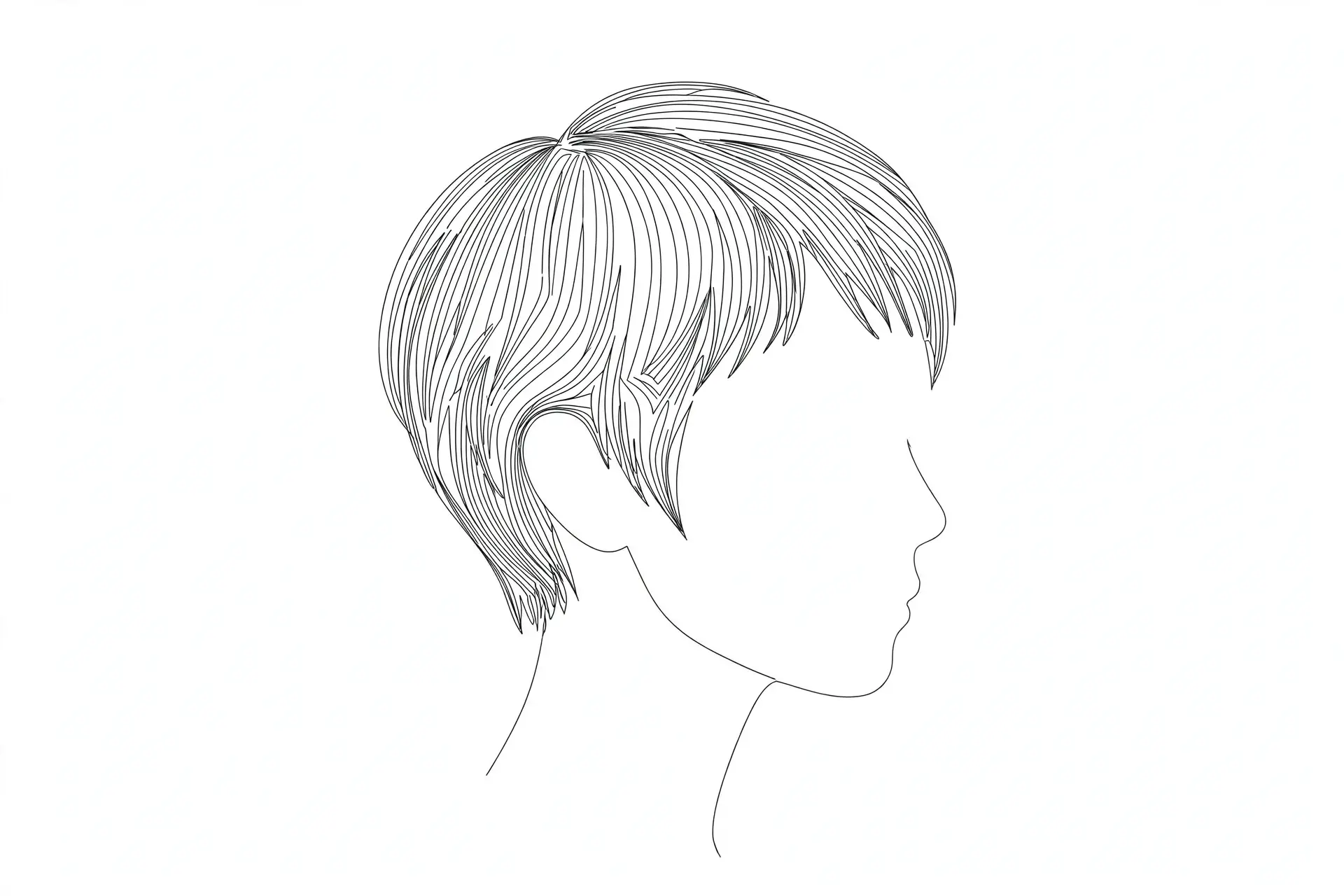
The Long Pixie Cut: Why Reference Photos Disappoint on Fat Faces
Bringing a curated photograph of a long, tousled pixie cut into a salon is the single most reliable path to disappointment on a fat face. Reference photographs capture hair that has either been curled with thermal tools or belongs to a model with natural wavy density. At 10 to 14 centimetres, naturally straight hair behaves like straight hair: it falls completely flat against the temples, forming a downward-sloping triangle that points directly at the jawline.
If your hair is straight, a longer pixie will never produce airy, separated crown volume straight out of the shower. You must commit to either a soft chemical body perm at the roots or a daily thermal styling routine.
For a long pixie tailored to a chubby face, the front face-framing pieces must be cut to 10 to 12 centimetres (3.9 to 4.7 inches), angled to hit mid-ear or the crest of the cheekbone—never lingering at mouth level where they widen the lower cheeks. The crown section requires 9 to 11 centimetres (3.5 to 4.3 inches) of length. To style it, use a thermal curling wand with a 19-millimetre (0.75-inch) to 25-millimetre (1.0-inch) barrel. Wrap only the mid-shafts for three seconds to build directional lift away from the face, leaving the final 2 centimetres (0.8 inches) straight so the perimeter looks clean rather than rounded into ringlets. These dimensions and heat guidelines are our page's operational rules for long pixie maintenance.
Double Chin and Jawline Softening: Why Blunt Cuts Widen the Lower Face
When a chubby face carries a double chin or a soft submental curve, two salon choices cause immediate visual widening: cutting the hair into a blunt, square bob-like boundary, and cutting a straight-across horizontal fringe. A blunt horizontal line acts as a visual horizon; it stops the viewer's eye and anchors focus precisely across the widest lower plane of the neck and jaw.
To eliminate that shelf, the haircut must never be cut blunt, and the perimeter must never be clipped into an aggressive horizontal edge. The side sections must be point-cut with texturizing shears so the pieces fall vertically 1.5 to 2.5 centimetres (0.6 to 1.0 inches) below the corner of the jawbone. This drop casts a subtle vertical shadow that interrupts the visual boundary between the jawline and the neck.
Your bangs must be cut on a steep 45-degree diagonal angle extending from the brow arch down to the cheekbone, creating an asymmetrical line that draws the eye upward toward the forehead. Maintain this cut on a strict 4 to 5-week schedule; after 6 weeks, growth at the nape flattens into a bulky ridge that doubles the visual weight of the chin. These tolerances are our own calibrated standards for softening lower-facial bulk.
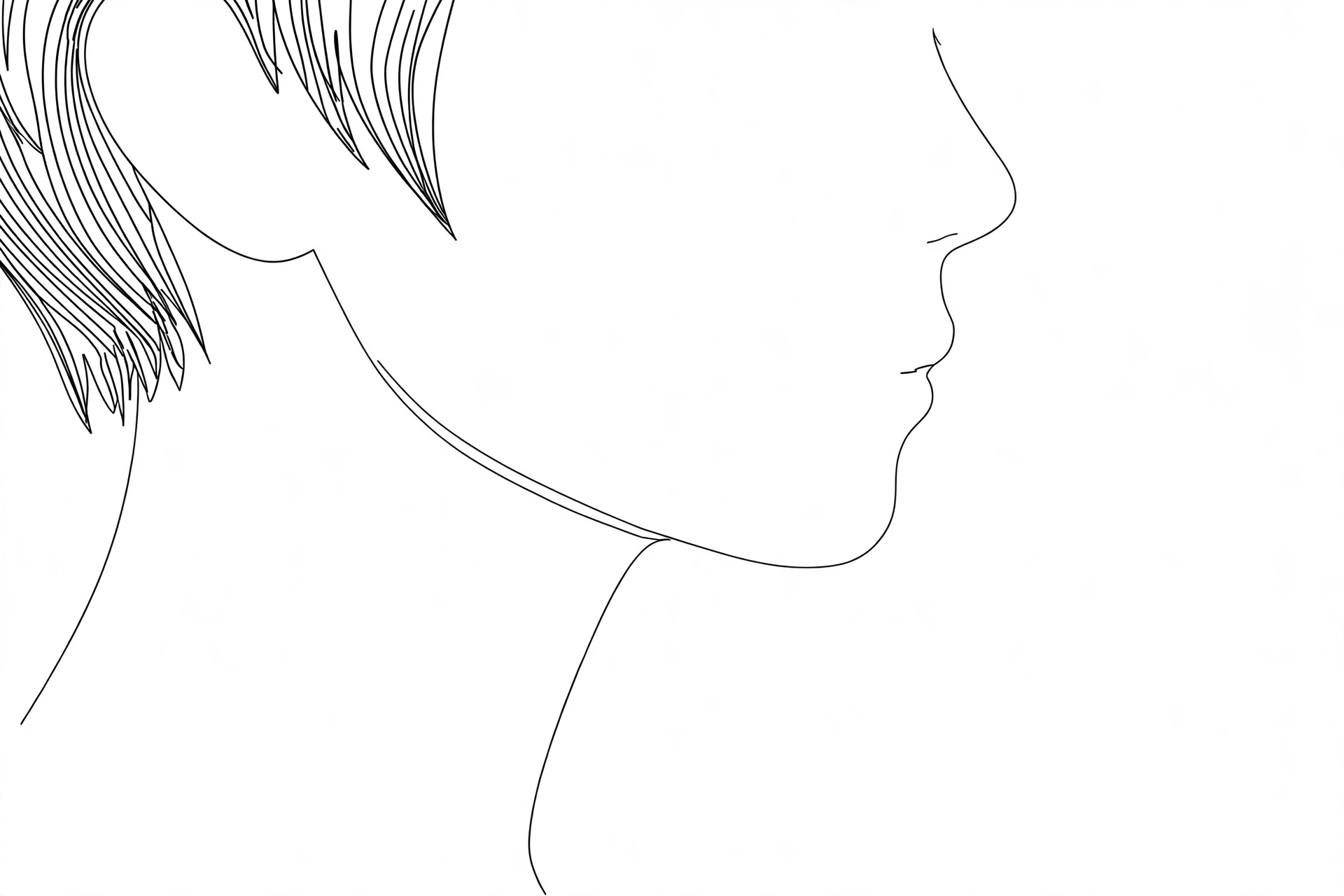
The Two-Tier Proportion Test: Measuring Your Jaw-to-Neck Clearance
Do not guess whether your proportions suit a cropped cut while looking in a mirror. Take a rigid straight ruler and measure your vertical submental drop: the distance from the underside of your jawline directly beneath your earlobe down to the top of your collarbone, while looking straight ahead with your chin level.
Based on this measurement, your cut falls into one of two tiers:
- Tier 1: High Neck Clearance (Greater than 6.5 centimetres / 2.6 inches)
You have sufficient vertical throat space to avoid crowding. You can safely wear a short, tapered nape of 1.5 to 2.5 centimetres (0.6 to 1.0 inches) and maintain top lengths between 8 and 10 centimetres (3.1 to 3.9 inches) to maximize vertical height without exposing neck bulk. - Tier 2: Compact Neck Clearance (6.5 centimetres / 2.6 inches or less)
Your jaw sits close to your upper neck, which causes short hair to bunch outward horizontally. Avoid ultra-short clipper work at the nape entirely. Keep the lower nape soft and thinned to 3.0 to 4.5 centimetres (1.2 to 1.8 inches), and ensure the side pieces in front of the ears extend at least 2.0 centimetres (0.8 inches) past the corner of your jawbone to preserve neck length.
This two-tier throat clearance scale is the specific measurement system formulated on this page, not a standard cosmetology textbook classification.
If you want to cross-reference your cheekbone-to-jaw width ratios before settling on your final salon blueprint, consult our companion breakdown on the pixie cut for round face before your stylist picks up the shears.
Disclosure: FaceShapeLens may earn an affiliate commission from qualifying purchases made through links on this page at no additional cost to you.